How Packaging Format Inverts Perceived Gift Type Category in UAE Corporate Eco-Tableware Programmes
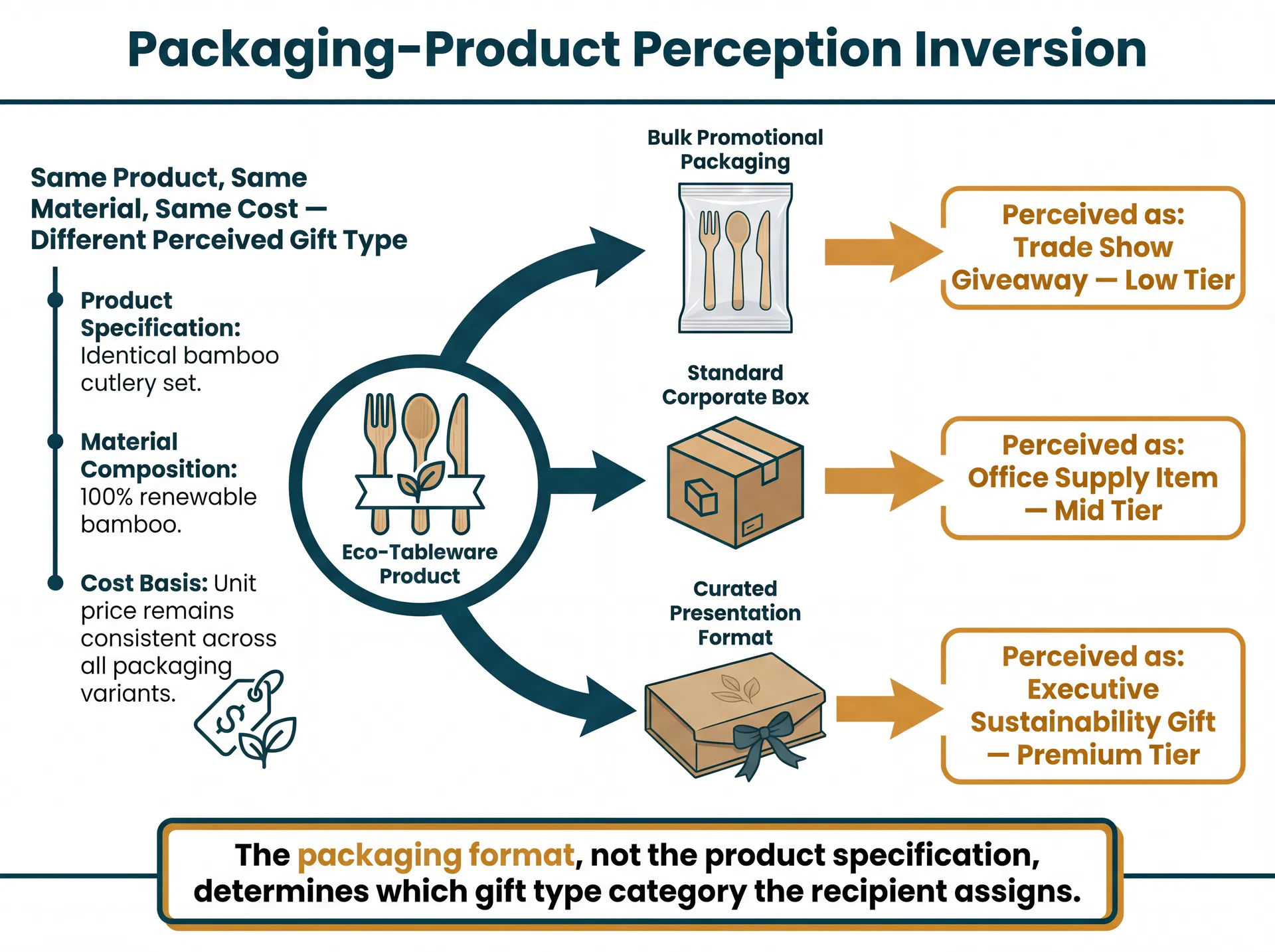
There is a structural problem in how most procurement teams evaluate corporate gift types that almost never gets surfaced during the selection process itself. The problem is not about choosing the wrong product. It is about the sequence in which decisions are made — and how that sequence creates a systematic inversion between what the procurement team believes they are sending and what the recipient actually perceives they have received. In practice, this is often where corporate gift type decisions start to be misjudged, not at the product specification stage, but at the packaging stage, which most organisations treat as a downstream logistics question rather than the primary signalling mechanism it actually is.
To understand why this happens, consider how a typical UAE corporate procurement workflow processes a gift programme. The sequence is almost always the same: first, the business need is identified — a client appreciation initiative, a sustainability showcase, a Ramadan distribution. Second, the gift type is selected — eco-tableware, specifically a bamboo cutlery set or a wheat straw bowl collection or a palm leaf dinnerware range. Third, the product specification is confirmed — material grade, branding method, colour, dimensions. And fourth, the packaging is selected, typically from whatever budget remains after the product cost, branding cost, and logistics cost have been allocated. This is the standard procurement decision architecture, and it seems entirely rational. The product is the gift. The packaging is the container. You decide what to give, then you decide how to wrap it.
The problem is that the recipient experiences this sequence in exact reverse. The recipient does not encounter the product first. They encounter the packaging first. The packaging is the first physical object they touch, the first visual signal they process, and the first basis on which they form a judgement about what kind of gift this is. By the time they open the packaging and discover the actual product, they have already categorised the gift. The packaging has already told them whether this is a promotional giveaway, a standard corporate acknowledgement, or a considered executive gesture. The product can confirm that initial categorisation or contradict it, but it cannot undo it. The first impression has already established the interpretive framework.
This creates what amounts to a perception inversion. The procurement team spent 80% of their evaluation time on the product and 20% on the packaging. The recipient spends the first 100% of their experience on the packaging before they ever see the product. The element that procurement treats as most important — the product specification, the material quality, the sustainability credentials — is the element that the recipient encounters last. And the element that procurement treats as least important — the packaging format — is the element that the recipient encounters first. The decision weight is inverted relative to the experience sequence.
We see the consequences of this inversion regularly in corporate eco-tableware programmes across the UAE market. A procurement team selects a genuinely premium product — say, a hand-finished bamboo cutlery set with food-grade stainless steel components and individual laser engraving. The unit cost is substantial. The material quality is excellent. The sustainability story is credible and well-documented. But the packaging budget was compressed because the product cost consumed more of the per-unit allocation than originally planned. So the set ships in a standard corrugated box with a printed sleeve — functional, clean, but indistinguishable from the packaging used for mid-range promotional items. The recipient receives the box, registers it as a standard corporate giveaway, opens it with corresponding expectations, and discovers a product that is significantly better than the packaging suggested. The reaction is not delight at the unexpected quality. The reaction is confusion. The packaging said one thing. The product says another. The gift type, as perceived by the recipient, lands somewhere between the two signals — lower than the product deserves, higher than the packaging promised. The procurement team invested in a premium gift type and delivered a mid-range perception.
The reverse scenario is equally common and arguably more instructive. A different procurement team selects a competent but unremarkable product — a standard bamboo fork-knife-spoon set with single-colour pad printing. The unit cost is modest. But the programme manager, understanding the importance of presentation in the UAE business context, allocates a meaningful portion of the budget to packaging: a rigid magnetic-close box with soft-touch lamination, a custom die-cut foam insert, and a belly band with bilingual Arabic-English branding in metallic foil. The recipient encounters the packaging first, registers it as a premium corporate gesture, opens it with corresponding expectations, and discovers a product that is adequate but not exceptional. The reaction is mild disappointment — but the overall perception of the gift type remains elevated because the packaging established the category before the product could contradict it. The first impression persists. The procurement team invested in a standard product and delivered a near-premium perception.
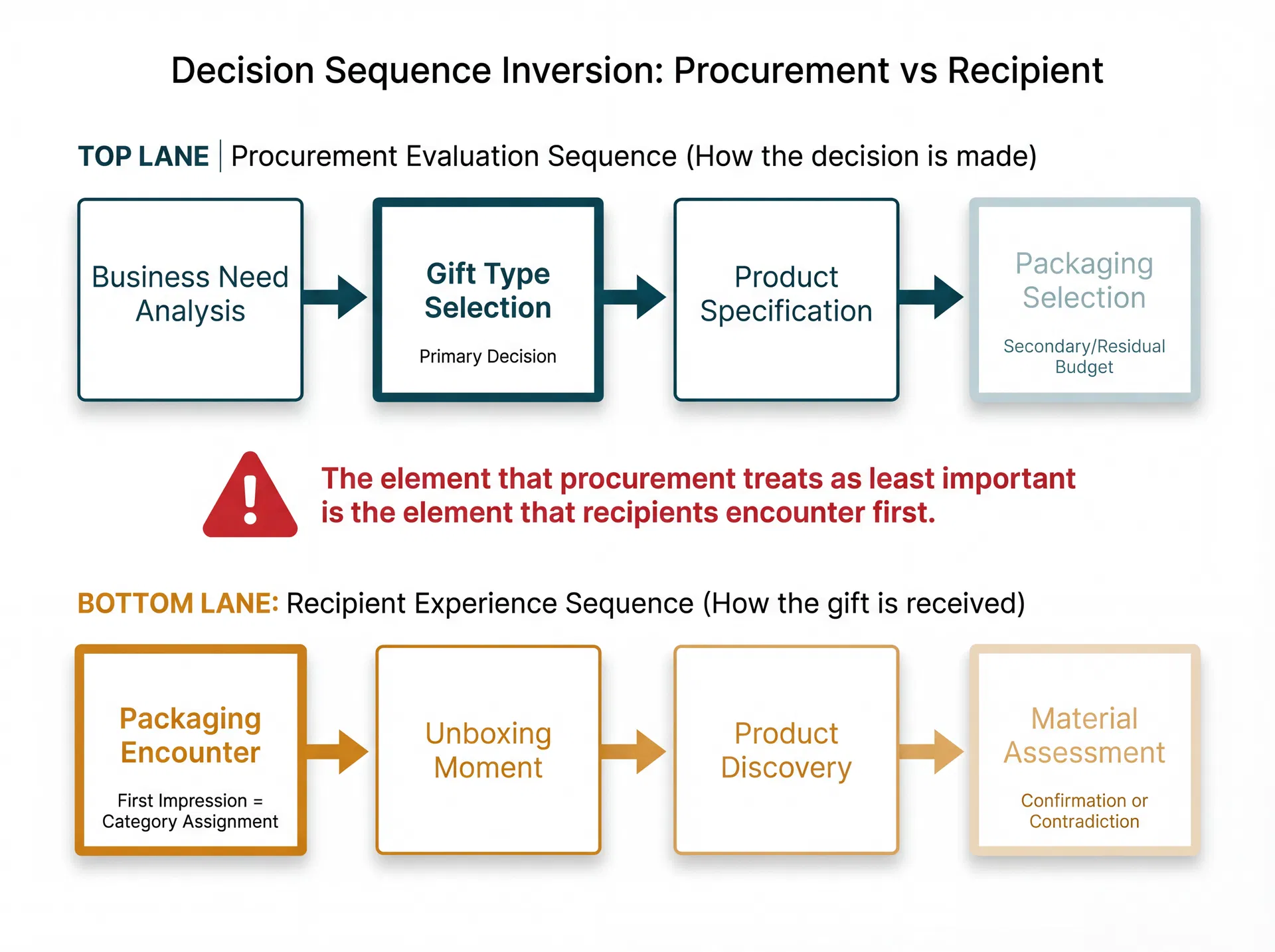
This is not a packaging quality argument. It is a decision architecture argument. The issue is not that procurement teams choose bad packaging — most teams select packaging that is appropriate for the budget and functional for the logistics chain. The issue is that packaging is positioned as a subordinate decision in the procurement sequence when it is actually the dominant signal in the recipient experience sequence. The decision architecture treats packaging as the last variable to be resolved, which means it absorbs whatever budget compression, timeline pressure, or specification trade-offs accumulated during the earlier stages. If the product cost came in higher than quoted, the packaging budget shrinks. If the branding process required an additional round of proofs, the packaging timeline compresses. If the logistics cost increased due to shipping route changes, the packaging specification is the first thing simplified. Every upstream pressure flows downstream into packaging because the decision architecture positions it as the most expendable element.
But from the recipient's perspective, the packaging is not the most expendable element. It is the most consequential element — at least in terms of initial category assignment. Research in consumer psychology has consistently demonstrated that packaging creates what amounts to a perceptual frame: the recipient processes the packaging cues, assigns the gift to a category, and then interprets the product through that categorical lens. A bamboo cutlery set discovered inside a kraft presentation box with embossed branding is interpreted as a sustainability-conscious executive gift. The identical bamboo cutlery set discovered inside a clear polybag with a header card is interpreted as a conference giveaway. The product has not changed. The material has not changed. The sustainability credentials have not changed. But the perceived gift type has shifted by two or three tiers because the packaging format told the recipient which category to assign before they ever touched the product.
In the UAE corporate context, this perception inversion carries additional weight because of the cultural significance of presentation in Gulf business relationships. The act of giving is evaluated not only on the intrinsic value of the gift but on the care and intentionality demonstrated through its presentation. A gift that arrives in considered packaging communicates that the sender invested thought and attention in the gesture — regardless of the product's unit cost. A gift that arrives in utilitarian packaging communicates efficiency and practicality, which are valued in operational contexts but can undermine the relational purpose of a corporate gift programme. The packaging format is not merely a container; it is a communication channel that transmits information about the sender's regard for the recipient. When procurement teams treat packaging as a logistics variable, they are inadvertently treating that communication channel as expendable.
The practical implication for gift type selection is significant. When a procurement team evaluates which types of eco-tableware gifts are appropriate for a specific business need, they typically compare product categories: cutlery sets versus bowl collections versus plate ranges versus multi-item presentation sets. They evaluate material quality, branding options, sustainability certifications, and unit cost. These are all relevant variables. But the evaluation almost never includes a systematic assessment of how the packaging format will modify the perceived category of each product option. A cutlery set in presentation packaging may be perceived as a higher gift type than a multi-item set in standard packaging — even though the multi-item set costs more, contains more components, and represents a more substantial product investment. The gift type, as experienced by the recipient, is a composite of product and packaging, and the packaging contribution to that composite is disproportionately large relative to its share of the procurement budget.
There is a further complication that makes this perception inversion particularly difficult to correct within standard procurement processes. Packaging decisions are often made by different people than product decisions. The product selection may involve the marketing team, the sustainability officer, and the procurement manager. The packaging selection may be delegated to the logistics coordinator or the supplier's account manager, who optimises for protection, stackability, and cost rather than for perceptual signalling. This organisational separation means that the person making the packaging decision may not fully understand the gift type positioning that the product decision was intended to achieve, and the person who made the product decision may not realise that the packaging decision has repositioned the gift type in the recipient's perception. The two decisions are made in isolation, but the recipient experiences them as a single, integrated signal. When those signals conflict, the packaging signal typically wins because it arrives first.
The correction is not to spend more on packaging — though in many cases a modest reallocation from product to packaging would improve the overall gift type perception. The correction is to restructure the decision sequence so that packaging format is evaluated simultaneously with product selection rather than sequentially after it. When a procurement team considers which gift types best serve their specific business needs, the evaluation should include the packaging format as an integral component of the gift type definition, not as a separate downstream specification. A "bamboo cutlery set in kraft presentation box" is a different gift type than "bamboo cutlery set in polybag with header card," even though the product is identical. The packaging format changes the category. Until procurement processes recognise this — until the decision architecture aligns with the recipient experience sequence rather than the internal workflow sequence — organisations will continue to invest in product quality that their packaging format systematically undermines, selecting one gift type in the evaluation room and delivering a different gift type to the recipient's desk.
Emirates Eco Tableware
Specialist supplier of branded eco-friendly cutlery for UAE corporate and hospitality markets