Why Multi-Stakeholder Gift Type Committees Produce Specification Drift That Collapses Corporate Eco-Tableware Programmes to Generic Defaults in UAE
The specification document arrives at our factory as a single PDF, but the revision history tells a different story. Version one, dated six weeks before the event, describes a premium bamboo cutlery set with custom Pantone-matched handles, laser-engraved bilingual branding, and a magnetic-closure gift box with embossed foil. Version three, two weeks later, replaces the Pantone matching with a standard colour from the factory palette because procurement flagged the per-unit cost of custom pigment mixing. Version five swaps the laser engraving for pad printing because the marketing team decided the logo needed to be larger than what laser technology can achieve on a curved bamboo surface. Version seven removes the magnetic-closure box entirely and substitutes a kraft paper sleeve because HR raised concerns that the original packaging felt too exclusive for an all-staff distribution. By version nine — the one that actually enters production — the specification describes a standard bamboo fork-and-spoon set with single-colour pad-printed logo in a generic kraft sleeve. It is, in every measurable sense, a different product from what was originally conceived.
This is not a failure of any individual department's judgment. Each revision was rational within its own frame of reference. The procurement team was correct that custom Pantone pigment mixing adds AED 2.40 per unit at the volumes specified. The marketing team was correct that a 28mm logo on a curved surface requires pad printing rather than laser engraving if brand guidelines mandate minimum clear space. HR was correct that magnetic-closure presentation boxes create a perceived hierarchy gap when distributed alongside standard-tier items at the same event. The problem is that these individually rational constraints, applied sequentially across four to six review rounds, produce a cumulative specification drift that no single stakeholder intended or even recognises as having occurred.
From the factory floor, this pattern is immediately visible because we track the delta between the initial specification and the production specification for every order. Across UAE corporate eco-tableware programmes that involve three or more internal stakeholders in the approval chain, the average specification retains only 35 to 40 percent of the features described in the original brief. The remaining 60 to 65 percent is not removed through deliberate strategic decision-making — it is eroded through sequential constraint layering, where each department adds its own requirements without visibility into how those requirements interact with constraints already imposed by other departments.
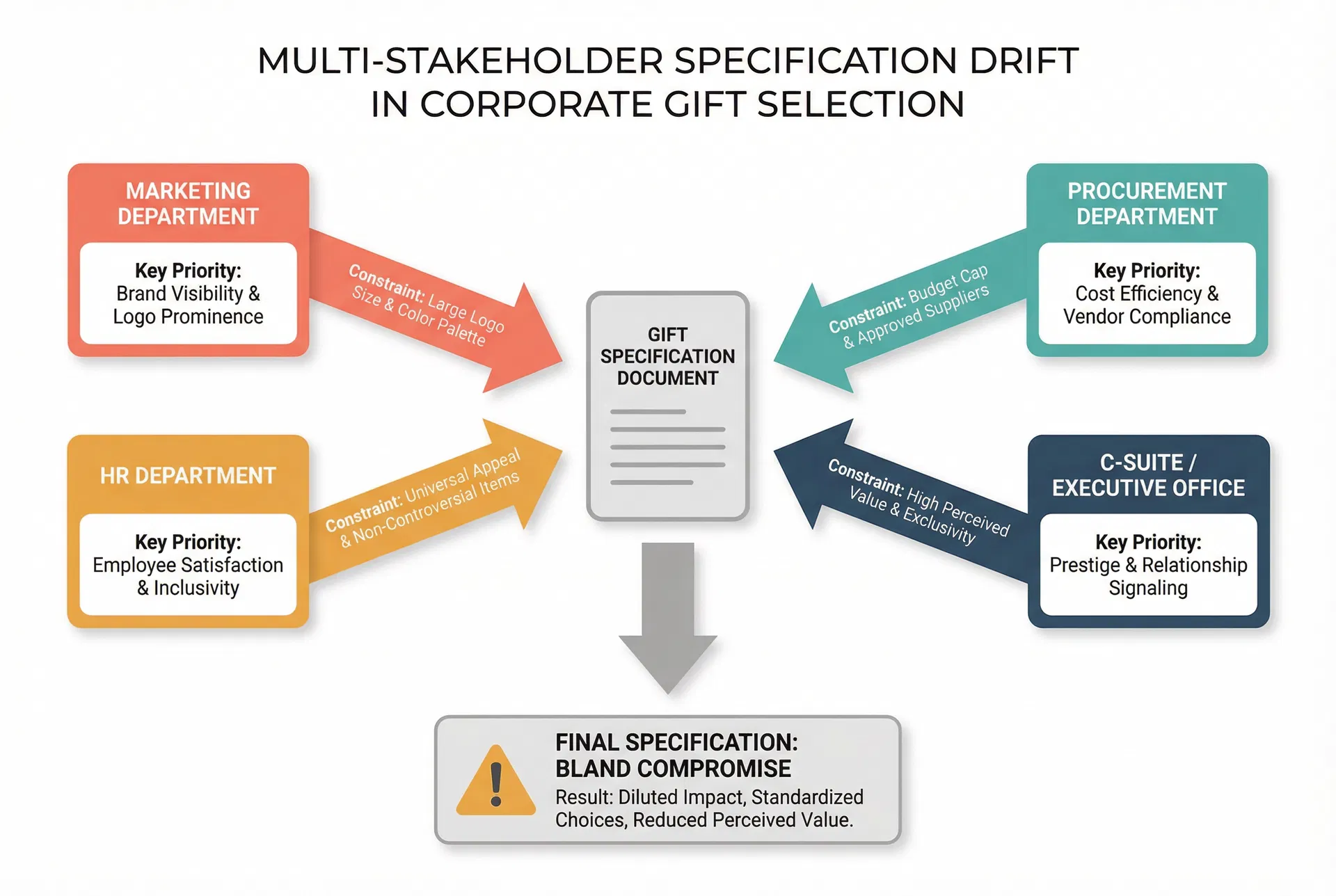
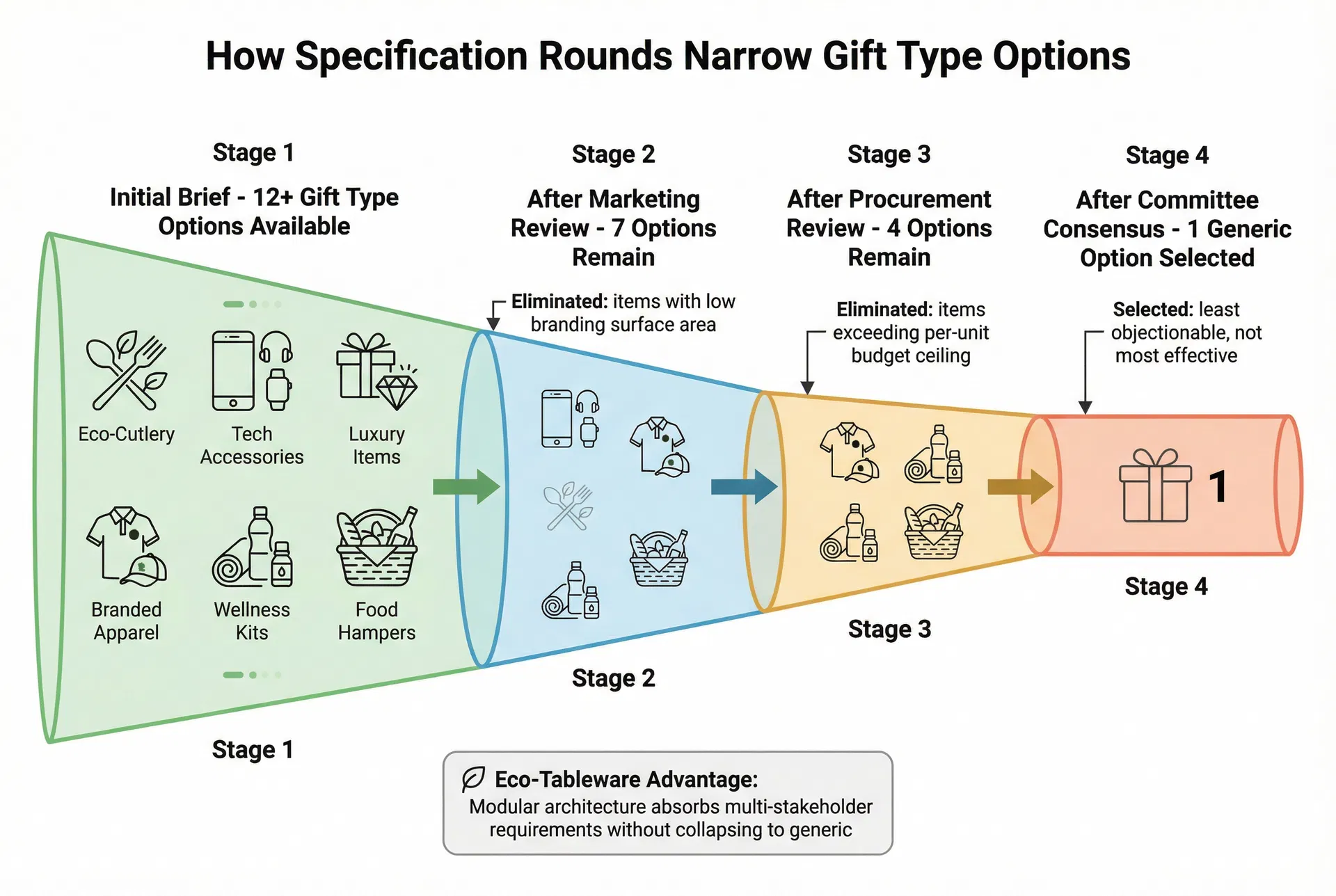
The mechanism operates through what project management literature calls satisficing rather than optimising. When a committee of stakeholders with different KPIs evaluates a gift type specification, the selection converges not on the option that best achieves any single objective, but on the option that is least objectionable to all parties. In practice, this means the final gift type is defined by the intersection of all departmental constraints rather than by the union of any department's aspirations. Marketing wants maximum brand surface area. Procurement wants minimum per-unit cost. HR wants universal appeal across a diverse workforce. The C-suite wants the gift to signal prestige in client-facing contexts. The only product configuration that simultaneously satisfies all four requirements is a generic item with modest branding, moderate cost, inoffensive aesthetics, and no distinguishing features — which is precisely the outcome that undermines the strategic purpose of the gifting programme.
The UAE corporate context amplifies this dynamic in specific ways. First, the stakeholder count in Gulf-region corporate gifting decisions is typically higher than in Western markets. A standard UAE corporate gift programme may involve the marketing department (brand alignment), procurement (vendor management and cost control), HR or people operations (employee experience), the CSR or sustainability team (ESG compliance), the executive assistant or protocol office (VIP recipient management), and sometimes a regional or group-level compliance function. Each of these stakeholders has legitimate authority to modify the specification, and each operates on a different evaluation timeline. The sustainability team may not review the specification until week three, by which point marketing and procurement have already locked in constraints that conflict with the sustainability team's requirements for certified material sourcing documentation.
Second, the cultural emphasis on consensus in UAE business decision-making means that specification conflicts are rarely resolved through explicit trade-off discussions. Instead, they are resolved through additive constraint layering — each department's requirement is accommodated by narrowing the specification rather than by explicitly choosing one department's priority over another's. The result is that no stakeholder feels their input was rejected, but every stakeholder's original vision has been diluted. The marketing team's premium branding concept becomes a standard logo stamp. The sustainability team's certified-material requirement becomes a generic "eco-friendly" label. The C-suite's prestige signaling becomes a slightly heavier paper stock on the sleeve. Each concession is small enough to seem reasonable in isolation, but the aggregate effect transforms the programme from a differentiated strategic asset into a commodity giveaway.
The factory-side impact of this specification drift is substantial and rarely visible to the client. Each revision round triggers a cascade of production planning changes. When the Pantone colour is dropped in favour of a standard palette option, the pigment sourcing timeline changes, which may shift the production slot. When laser engraving is replaced by pad printing, the tooling setup changes, which affects the quality inspection protocol. When the packaging is downgraded from a rigid box to a kraft sleeve, the assembly line configuration changes, which alters the per-unit labour time. By the time the ninth revision arrives, the factory has effectively planned three different products and will produce only one. The cost of those abandoned production plans — wasted tooling preparation, cancelled material orders, rescheduled line time — is absorbed into the factory's overhead and eventually reflected in pricing for future orders, but it never appears as a line item on the client's purchase order.
There is a structural reason why this problem persists across organisations that are otherwise sophisticated in their procurement practices. The gift type specification is treated as a single document that moves linearly through an approval chain, when it should be treated as a set of independent parameters that are locked at different stages. In a well-structured specification process, the material type (bamboo, wheat straw, stainless steel, PLA) would be locked at the first review stage because it determines the entire downstream production pathway. The branding method (laser engraving, pad printing, UV printing, debossing) would be locked at the second stage because it determines tooling requirements. The packaging format would be locked at the third stage because it determines assembly line configuration. Instead, what typically happens is that all parameters remain open for revision at every stage, which means a late-stage change to packaging can retroactively invalidate a branding method decision that was made three weeks earlier.
The practical consequence for UAE corporate buyers is that the gift type they believe they are selecting at the committee level is often not the gift type that arrives at the distribution event. The committee approved a concept. The production floor manufactured a compromise. The gap between these two is the specification drift zone, and it is where most corporate eco-tableware gift programme value is lost. When organisations later evaluate which gift types best serve their specific business needs, they are typically evaluating the compromised version rather than the originally specified version — which means their assessment of the gift type's effectiveness is contaminated by specification drift they may not even be aware occurred.
The corrective approach is not to reduce the number of stakeholders — each department's input is genuinely valuable — but to restructure how their input is sequenced and bounded. A parameter-locking protocol, where material, branding method, and packaging format are each finalised at designated review gates and cannot be reopened at subsequent stages, prevents the cascading constraint accumulation that produces generic outcomes. This requires the initial brief to explicitly define which parameters are strategic (and therefore locked early by the business objective owner) and which are tactical (and therefore adjustable within bounded ranges by operational stakeholders). In our experience, organisations that implement even a basic version of this protocol retain 70 to 80 percent of their original specification features through to production, compared to the 35 to 40 percent retention rate in unstructured committee processes.
The deeper issue is one of accountability architecture. In a typical multi-stakeholder gift programme, no single person owns the specification integrity from brief to delivery. The marketing manager owns the brand guidelines. The procurement officer owns the vendor relationship. The HR business partner owns the distribution logistics. The sustainability coordinator owns the compliance documentation. But no one owns the question of whether the final product still achieves the business objective that justified the programme budget. This accountability gap is where specification drift lives, and it is why organisations that invest significant budget in corporate eco-tableware gift programmes frequently receive products that are technically compliant with every department's individual requirements but strategically ineffective as business relationship tools.
The eco-tableware category is particularly susceptible to this drift because it sits at the intersection of multiple departmental mandates. Unlike a simple branded pen or USB drive — where the specification has few adjustable parameters — an eco-tableware set involves material selection (with sustainability implications), branding method (with marketing implications), packaging design (with cost and perception implications), and product configuration (with recipient hierarchy implications). Each of these parameters is a surface that a different stakeholder can modify, and the more surfaces available for modification, the greater the cumulative drift. The irony is that the very complexity that makes eco-tableware a strategically rich gift category also makes it the category most vulnerable to committee-driven specification collapse.
Emirates Eco Tableware
Specialist supplier of branded eco-friendly cutlery for UAE corporate and hospitality markets