How Procurement Timeline Compression Silently Downgrades Corporate Eco-Tableware Gift Type Decisions in UAE Programmes
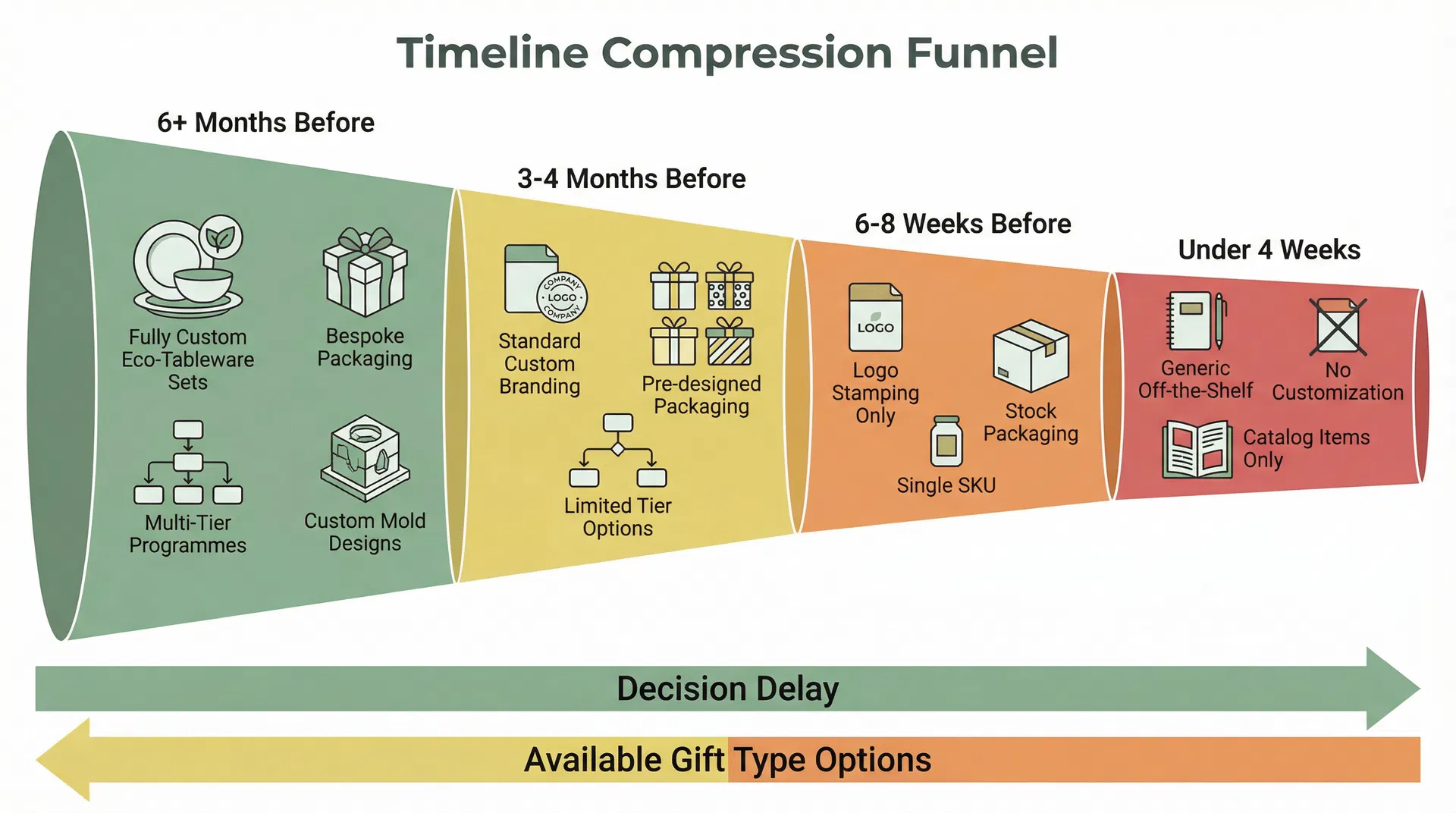
There is a conversation that happens internally at least once a quarter, and it always follows the same arc. A procurement lead contacts us about a corporate eco-tableware gift programme for an upcoming UAE business occasion — National Day, a Ramadan appreciation initiative, a year-end client recognition event. The brief is detailed. They want custom mold designs, bespoke packaging with bilingual branding, a multi-tier configuration that differentiates between executive recipients and general staff. The specifications are thoughtful. The problem is the date on the email. The event is seven weeks away, and the programme they have described requires twelve.
What follows is not a negotiation about quality or price. It is a systematic downgrade of the gift type itself, driven entirely by the gap between when the decision was made and when the product must arrive. The procurement team did not choose a simpler gift type because they evaluated the options and concluded that basic branding was strategically superior. They chose it because the timeline left no alternative. The internal record will show a gift type selection decision. What actually occurred was a timeline-forced compromise that no one formally acknowledged as such.
In practice, this is often where corporate gift type decisions for UAE programmes start to be misjudged — not at the point of evaluation, but at the point of timing. Most procurement frameworks treat gift type selection and procurement timeline as independent variables: first you decide what you want, then you figure out when to order it. The reality on the supply side is that these two variables are deeply coupled. The gift type you can actually deliver is a direct function of when you commit to the decision. A fully customised eco-tableware set with bespoke packaging, custom colour matching, and multi-tier recipient configurations requires a minimum of ten to twelve weeks from design approval to UAE delivery. That window includes material sourcing for sustainable substrates, tooling setup or adjustment, sample production and approval cycles, bulk manufacturing, quality inspection, packaging assembly, and international freight with customs clearance. Each of these stages has a floor duration that cannot be compressed without introducing defect risk.
When a procurement team delays the gift type decision by even four weeks — which is common when internal stakeholder alignment takes longer than expected, or when budget approval cycles extend into the next quarter — the available gift type options contract sharply. At twelve weeks out, the full spectrum of eco-tableware configurations is available: custom molds, Pantone-matched colours, bespoke packaging with embossed logos, multi-tier sets differentiated by recipient seniority. At eight weeks, custom molds are no longer feasible, but standard shapes with custom colour and branding remain possible. At five to six weeks, the options narrow to logo stamping on stock items with pre-designed packaging templates. Under four weeks, the only viable path is selecting from existing catalog inventory with no customisation beyond a printed sleeve or adhesive label.
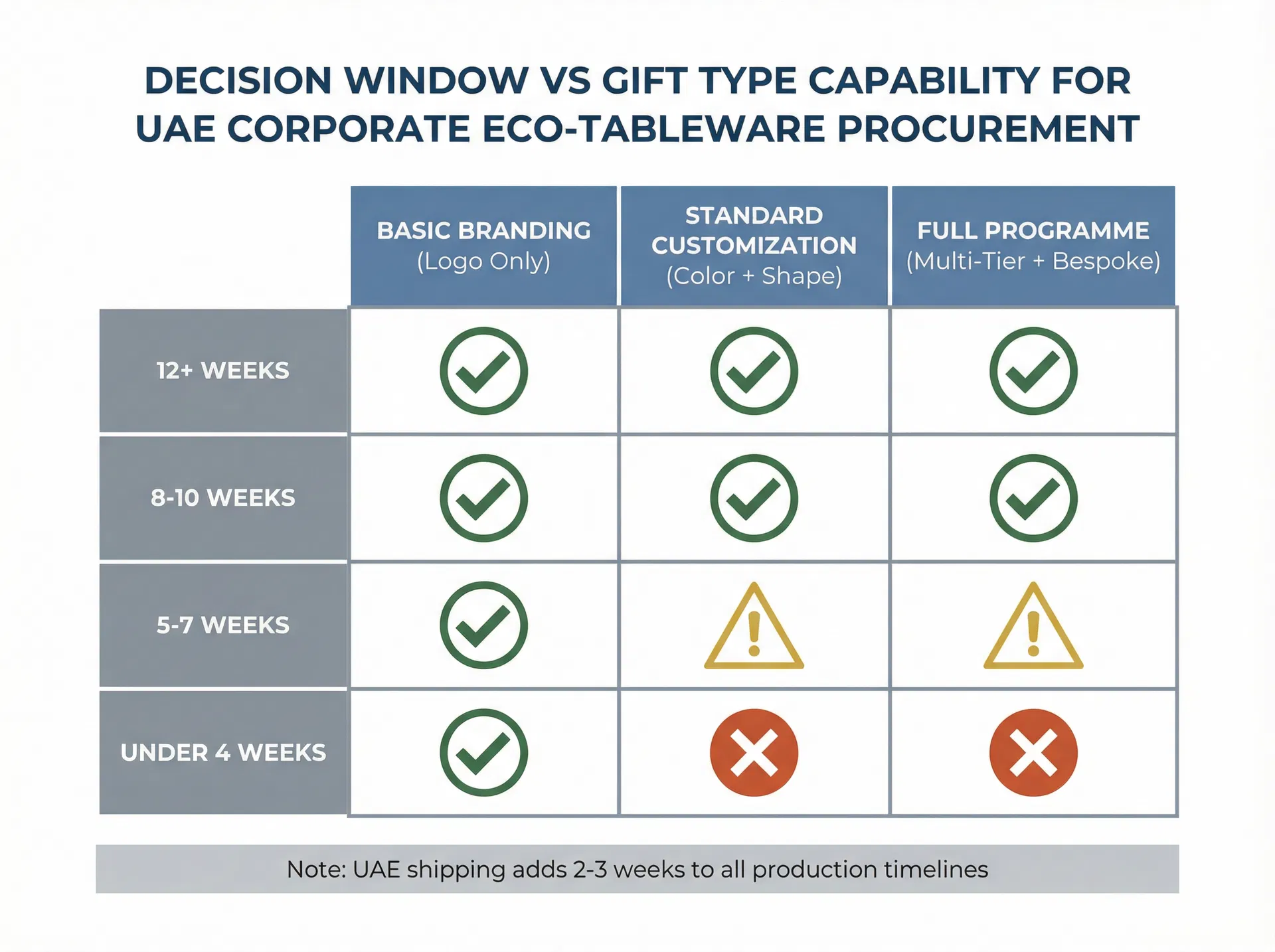
The UAE market compounds this dynamic in ways that are not immediately obvious to procurement teams based in the region. International freight from manufacturing facilities in East or Southeast Asia to UAE ports adds two to three weeks to every production timeline. This means that a five-week production window actually requires an eight-week decision horizon when shipping is included. Procurement teams who benchmark their timelines against domestic suppliers or digital product vendors consistently underestimate this buffer. The result is that they believe they are making a decision with adequate lead time when, from the factory's perspective, they have already crossed the threshold where meaningful customisation is possible.
There is also a seasonal compression effect that is specific to the UAE corporate gifting calendar. The concentration of high-volume occasions — Ramadan, Eid al-Fitr, UAE National Day, and the Western year-end holiday period — creates overlapping demand peaks that reduce available production capacity precisely when procurement teams are most likely to be placing orders. A factory that can accommodate a custom eco-tableware programme with a ten-week lead time in March may require fourteen weeks for the same specification in September, because production lines are already committed to other UAE and Gulf region orders. The procurement team's timeline calculation, based on a standard lead time quoted during a quieter period, becomes invalid without anyone formally revising it.
The structural issue is that most organisations do not have a mechanism for connecting gift type ambition to procurement calendar discipline. The marketing or HR team that originates the gifting initiative operates on an event-driven timeline: the occasion is fixed, and the gift programme is planned backward from that date. The procurement team that executes the order operates on a process-driven timeline: vendor selection, budget approval, specification finalisation, purchase order issuance. These two timelines frequently collide, and the collision point is where the gift type gets downgraded. The marketing team's vision of a bespoke eco-tableware set with custom packaging enters the procurement system and emerges as a stock item with a logo sticker, not because anyone decided that was the better option, but because the process consumed the time that the customisation required.
From a cost perspective, the timeline-forced downgrade often appears to save money in the short term. A generic catalog item costs less per unit than a fully customised programme. But this comparison ignores the strategic cost of the downgrade. The original gift type was selected to achieve a specific business objective — client retention, employee engagement, brand differentiation. The downgraded version may still arrive on time, but it no longer carries the differentiation that justified the programme in the first place. The procurement system records a successful on-time delivery. The business objective that motivated the programme goes unmeasured and unmet. When teams later evaluate which types of corporate gifts best serve different business needs, they rarely account for the fact that the gift type they actually delivered was not the gift type they originally selected.
The pattern repeats because the root cause is invisible in standard procurement reporting. No dashboard tracks the gap between the gift type that was specified and the gift type that was delivered. No metric captures the number of customisation features that were dropped between the initial brief and the final purchase order. The procurement team reports that the gift programme was executed on time and within budget. The marketing team reports that the event occurred as planned. The fact that the gift itself was a fundamentally different product from what was originally envisioned — carrying different brand impact, different recipient perception, and different programme ROI — is lost in the gap between these two reports.
The practical implication for UAE corporate buyers sourcing eco-tableware gifts is straightforward but rarely implemented: the gift type decision must be made before the procurement process begins, not during it. If the business objective requires a fully customised eco-tableware programme with bespoke packaging and multi-tier configurations, the decision window opens at minimum fourteen weeks before the delivery date — not fourteen weeks before the event, but fourteen weeks before the gift must be in the recipient's hands, which may be days or weeks before the event itself. Organisations that treat gift type selection as a procurement task rather than a strategic planning task will continue to experience systematic downgrade, and will continue to attribute the underwhelming results to the gift category rather than to their own decision timing.
Emirates Eco Tableware
Specialist supplier of branded eco-friendly cutlery for UAE corporate and hospitality markets